


New Research on the Cultural History of (Jewish) Enlightenment
The latest issue of Naharaim: Journal of German-Jewish Literature and Cultural History, a special issue titled "German Jews and the Arts: Composition, Contemplation, Critique", opens with the open access article “Moses Samuel Lowe – Engraver, Draughtsman and Miniature Painter of German (Jewish) Enlightenment“ by Dr. Uta Lohmann
The essay sheds light on the life and work of the almost forgotten engraver and miniature painter Moses Samuel Lowe (1756–1831). As one of the first Jewish artists to receive an academic education, Lowe was characterized by tireless creativity and inventiveness. He gained his artistic experience mainly within the sociable circles of the Berlin Enlightenment and the intellectual networks of the Prussian Haskalah. The portraits he created gave many thinkers of these scholarly and literary circles a visual identity. Throughout his life, Lowe remained ideologically and conceptually connected to several Jewish Enlightenment thinkers, providing illustrations for their publications that, through their aesthetic expressiveness, served the vivid cognition of the recipients.
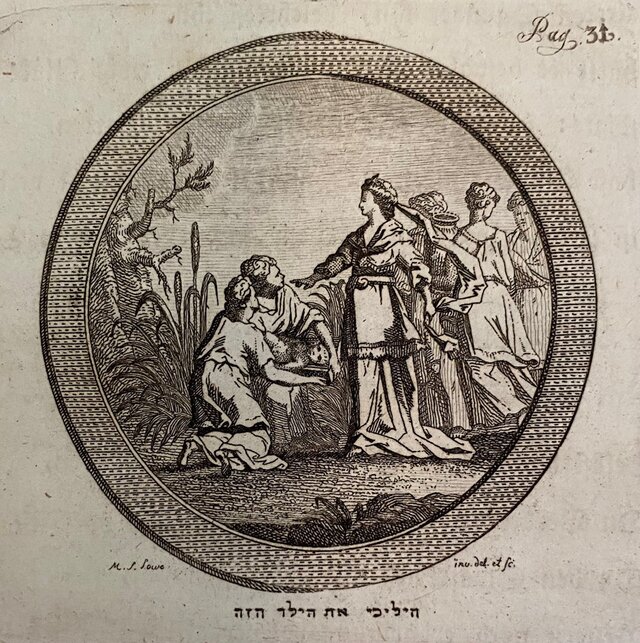
Impressive examples are the vignettes that Lowe engraved in copper for Naphtali Herz Wessely’s heroic epic about the life of the biblical Moses, which were printed in both the original Hebrew edition (Shire Tiferet, 1789) and the German translation (Moseide, 1795).
Figure: Illustration of Moses’ rescue by Pharaoh’s daughter by Moses Samuel Lowe in Naphtali Herz Wessely's „Die Moseide“ (1795). Source: Institute for the History of the German Jews, Hamburg